
Inside the Bank of Baroda Breach: What a Single Compromised Inbox Exposed

On July 24, 2026, a relatively obscure extortion group calling itself TripleX did something most ransomware crews don't bother with: they gave the data away for free. Roughly a terabyte of what the group claims is Bank of Baroda's customer and internal data appeared on a dark web forum, no payment wall, no negotiation thread. Three days later, the bank confirmed an incident — carefully, without confirming the scale.
That gap between "1TB dumped publicly" and "an employee's email account was compromised" is where this story actually lives, and it's worth sitting with for anyone running security at an Indian financial institution.
What Was Allegedly Exposed
Samples tied to the leak, reviewed by independent researchers, reportedly include a wide spread of banking data: savings and current account records, loan account details, net banking user information, NRI account data, and corporate banking service records tied to specific branches and ATMs. Some of the circulated samples also contain government-issued ID numbers and phone numbers — the kind of data that turns a breach into a fraud and phishing problem long after the headlines fade.
Bank of Baroda's position, stated publicly, is narrower: an employee's email account was compromised, resulting in unauthorized access to "certain data," and its core banking systems were never touched. Both things can be true at once — a contained technical footprint and a large reputational and customer-trust problem. That's usually how these incidents actually play out.
The Timeline
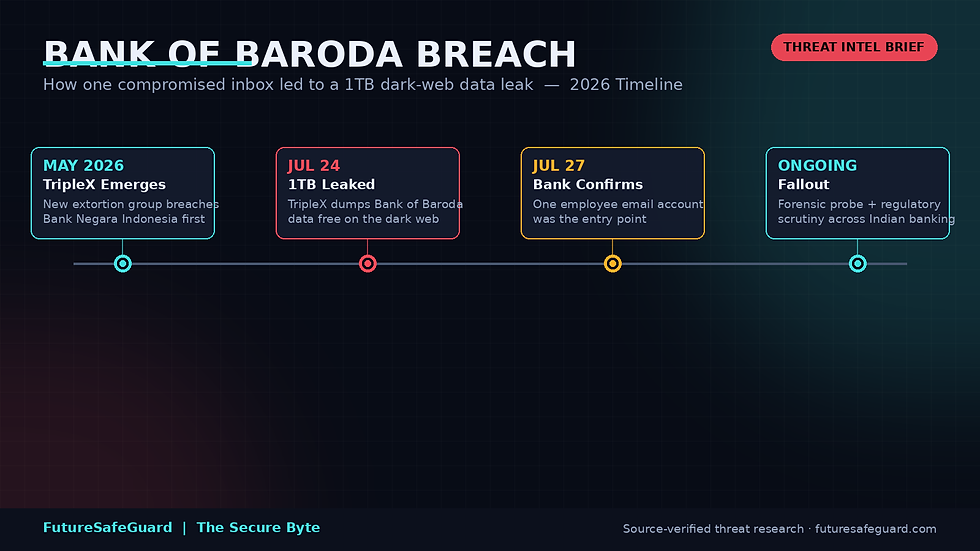
- **May 2026** — TripleX surfaces for the first time, breaching PT Bank Negara Indonesia, a major Indonesian state-owned bank, leaking customer contracts and passport data.
- **July 24, 2026** — TripleX publishes what it claims is ~1TB of Bank of Baroda data on the dark web.
- **July 27, 2026** — Bank of Baroda issues its first public statement, confirming an email account compromise and denying core system access.
- **Ongoing** — Forensic investigation continues; the incident is drawing scrutiny from Indian regulators and cybersecurity researchers dissecting the sample data.
*(See the accompanying timeline graphic for a visual version of this.)*
Why This Attack Pattern Should Worry You More Than a Zero-Day Would
Here's the detail that should sit uncomfortably with every CISO reading this: there's no evidence of a sophisticated exploit chain. No zero-day, no custom malware framework, no supply-chain compromise. The reported entry point is a single employee email account — likely reached through a weak password, credential reuse, or a phishing hook.
That's not a story about TripleX being technically brilliant. It's a story about how much damage a completely unremarkable initial-access technique can do once it lands in the right inbox. Bank of Baroda is TripleX's second confirmed target after Indonesia's BNI, and the pattern is consistent across both: identify a soft entry point, exfiltrate broadly rather than surgically, and publish rather than negotiate — trading potential ransom income for maximum reputational damage.
This isn't an isolated pattern in Indian finance and telecom either. Similar allegations have hit other large Indian enterprises in recent years, and the common thread is rarely a sophisticated attack — it's a single point of compromise, delayed disclosure, and customers finding out from social media before they hear from the institution holding their data.
The Bigger Picture: India's Breach Economics Are Getting Worse
This incident isn't happening in a vacuum. The average cost of a data breach in India hit a record high this year, up nearly 16% year-over-year, and the financial sector is absorbing the worst of it — average breach costs there are running well above the national figure. A meaningful share of this year's malicious breaches involved AI-generated attack techniques, which tracks with what defenders have been warning about for the past two years: attackers are industrializing the cheap, high-volume parts of an attack (phishing content, reconnaissance, credential stuffing) faster than most mid-sized institutions can industrialize their defenses.
Organizations with mature AI-assisted detection and automation are seeing meaningfully lower average breach costs than those without. That gap is likely to widen, not close.
What Indian Financial Institutions Should Take From This
1. **Email account compromise is still the top attack surface.** Multi-factor authentication on every privileged and executive inbox is table stakes, not a nice-to-have.
2. **Assume broad exfiltration is possible from a single compromised account.** Segment access so one mailbox can't touch loan records, NRI account data, and corporate banking systems simultaneously.
3. **Plan your disclosure timeline before you need it.** The three-day gap between the leak surfacing and the bank's statement is a recurring criticism in incidents like this — have a communication protocol ready, not improvised.
4. **Treat vendor and partner banks as part of your blast radius.** TripleX's move from an Indonesian bank to an Indian one in under two months shows these groups are not regionally constrained.
**Sources referenced:** The Record from Recorded Future News; IBM Cost of a Data Breach Report 2026 (via NewKerala); PBX Science; Skeletos.io; Threatsys Cybersecurity.


Comments